Guides
Humidity-resistant pantry storage for Houston and Gulf Coast homes
Humidity-resistant pantry storage in Houston means sealed edges, tight doors, and moving air, chosen for a climate that stays damp most of the year.
What to take away
- Sealed edges matter more than shelf strength. Moisture enters melamine and plywood through raw cuts, not through the face.
- Melamine-faced board, sealed plywood, and powder-coated steel are the practical Gulf Coast choices. Bare particleboard and unfinished OSB are not.
- A closed pantry needs moving air. An exhaust fan vented outside or a drained dehumidifier does more than any single storage product.
- Keep a humidity meter in the room. Under 60 percent is the working target; above 65 percent, find out why.
- Anchor shelving into studs, keep the bottom shelf clear, and store flour, rice, and paper goods in gasketed containers.
What Houston air does to a pantry
Houston runs humid most of the year. Summer dew points stay high, so indoor air holds moisture even with the air conditioner working. Houston's climate pairs Gulf moisture with a long cooling season, and a pantry sits in that air around the clock.
Dry goods take on that moisture. Flour clumps, crackers go soft, sugar hardens into a block, spices cake. A better jar slows this down but cannot stop it, because the room keeps supplying water.
The larger risk is biological. Mold needs moisture, and the EPA's moisture control principles for humid climates explain how damp surfaces and high indoor humidity create the conditions it needs: EPA moisture control principles.
Shelving degrades on its own schedule. Particleboard swells along cut edges and never returns to shape. Steel rusts at scratches and welds. Wire racks drop crumbs onto whatever sits below, and dust holds moisture against that surface.
Many Houston pantries sit against exterior walls or beside garages. Those walls run warmer and damper than interior partitions, which is why one shelf unit can fail here and last years in a dry climate. The same logic governs a wet bathroom, where humidity-resistant storage follows identical rules.
Materials that survive the Gulf Coast
Material choice decides how the pantry ages. You want a surface that does not absorb water and edges that are sealed rather than raw.
Pantry Materials for Houston
Material
- Melamine-faced board
- Resists surface water
- Sealed plywood
- Tolerates damp
- Powder-coated steel
- Rusts at breaks
- Stainless steel
- Highly resistant
- Chrome wire
- Open, rust risk
- Solid wood
- Moves with humidity
Moisture behavior
- Melamine-faced board
- Wipe dry, reseal
- Sealed plywood
- Recoat edges
- Powder-coated steel
- Touch up scratches
- Stainless steel
- Costs more
- Chrome wire
- Check welds
- Solid wood
- Needs film finish
Upkeep
- Melamine-faced board
- Sealed plywood
- Powder-coated steel
- Stainless steel
- Chrome wire
- Solid wood
| Material | Moisture behavior | Upkeep in Houston |
|---|---|---|
| Melamine-faced board | Resists surface water, swells at unsealed cuts | Wipe dry, reseal chips |
| Sealed plywood | Tolerates damp better than particleboard | Recoat edges every few years |
| Powder-coated steel | Rusts only where coating breaks | Touch up scratches |
| Stainless steel | Highly moisture resistant | Costs more, cleans easily |
| Chrome wire | Open, but carries rust risk | Check welds and feet |
| Solid wood | Moves with humidity | Needs a film finish |
Melamine is the practical default. It wipes clean, handles spills, and costs less than stainless. Its weakness is the cut edge, covered below.
Powder-coated steel suits adjustable shelving because the coating wraps the whole surface. Check feet and cut ends, where rust starts first in a coastal home.
Solid wood works with a real film finish, not oil or wax. Wood moves as humidity swings, so leave small gaps at wall contacts and do not overtighten brackets.
Bare particleboard, unsealed MDF, and unfinished oriented strand board all take on water at exposed edges and lose strength. If you are weighing cost against upkeep across these options, the trade-offs are the same ones that appear when comparing particleboard, plywood, steel, or wire in any humid room.
Sealing edges, joints, and doors
Sealant closes the gaps materials leave behind. Use a low-VOC, mold-resistant silicone or acrylic caulk at shelf-to-wall joints, around pipe penetrations, and along base trim inside the pantry.
Cut edges of melamine and plywood need edge banding or a sealant coat. This is the most common failure point in Houston shelving, because moisture enters the core and the panel swells from inside.
Let sealant cure fully before loading shelves. Trapped solvent under stored goods is a poor start in a closed room.
Door gaskets matter more than most people expect. A compressible gasket stops pantry air from trading with kitchen air, which helps if you run a dehumidifier inside and keeps cooking steam out.
A solid-core or sealed-core door resists warping better than a hollow one. A hollow door with a failed skin traps moisture and swells at the bottom edge.
Louvered doors trade humidity control for airflow. Use them only where the pantry already has active ventilation. Otherwise they just let damp kitchen air in.
The sealing approach here overlaps with what works in damp basements and hot attics, where the same materials fail the same way.
Ventilation and dehumidification
Ventilation is where most Houston pantries fail. A closed room with no air movement holds moisture, and the EPA treats moisture control and ventilation as linked concerns: EPA indoor air quality guidance.
Three setups work in a typical pantry:
- A small exhaust fan vented outside, on a timer or humidity sensor.
- A standalone dehumidifier sized for the room and drained so it never needs emptying.
- A louvered door plus a circulation fan, only where kitchen air is already conditioned and dry.
Never vent pantry exhaust into an attic or wall cavity. That pushes moisture into the structure, which is worse than leaving it in the room.
A humidity meter costs little and ends arguments. Keep the pantry under about 60 percent where you can, and treat readings above 65 percent as a signal to run the dehumidifier longer and look for water entry.
Do not block vents with shelving or stored goods. Leave clearance above the top shelf and below the bottom one so air has a path.
Smell is an early warning. A musty pantry usually means damp material somewhere, not just old food. The EPA's guidance on preventing mold in damp storage areas covers how to find and dry those spots: EPA mold and moisture guide.
Storm season and coastal building practice
Gulf Coast building practice assumes water will get in eventually. That shapes how a pantry is built and stocked.
Anchor shelving into studs rather than drywall alone. In storm season a shifting shelf becomes a falling shelf, and glass jars finish the job.
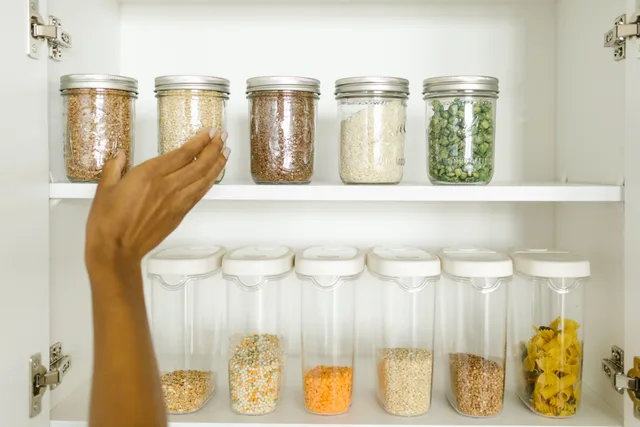
Store anything that absorbs water in gasketed bins or jars. Flour, rice, sugar, pasta, and paper goods all qualify. Cardboard boxes and paper bags wick moisture and hold it against food.
Keep the lowest shelf clear. If water enters during a storm, the bottom foot of the pantry is where it pools, and goods stored there are lost first.
Storm season also brings outages that stop air conditioning and dehumidification together. NOAA's seasonal outlook is worth checking each year while planning supplies: NOAA hurricane outlook.
After any storm or long outage, inspect before restocking. Damp shelves, soft edges, and a musty smell mean the room needs drying and possibly resealing first. If you are planning a rebuild, budget the work honestly rather than assuming a weekend, because a full pantry organization project with sealing and ventilation runs longer than swapping shelves.
A twice-a-year inspection
Twice a year covers most Houston homes, with an extra pass after any storm or plumbing leak. Spring and fall line up with the local humidity swings.
Twice-a-Year Pantry Inspection
- Read humidity meter before opening
- Check shelf edges for softness
- Look for rust at steel feet
- Inspect sealant lines for cracks
- Test door gasket with paper strip
- Clear dust from vents
- Check dates and rotate stock
Replace anything swollen rather than drying it. Swollen particleboard does not return to shape, and a soft edge is a moisture path into the core.
Reseal small gaps as you find them. A tube of mold-resistant caulk and a few minutes twice a year prevents most of the damage that shows up later.
Track what fails and where. If the same corner swells every year, the problem is water entry or airflow, not the shelf. Fixing the cause costs less than replacing boards on a schedule, and it belongs in a broader pantry organization maintenance routine.
Common questions
Does a dehumidifier actually help a pantry in Houston?
Yes, if the room closes and the unit drains continuously. It lowers humidity directly, which is the condition mold and soft dry goods depend on. Pair it with a meter so you can see whether it keeps up.
Is wire shelving a bad choice near the Gulf Coast?
Not automatically. Wire allows airflow, which helps, but chrome rusts at scratches and welds. Powder-coated or stainless wire holds up better, and any wire shelf needs a rust check twice a year.
How often should pantry shelves be resealed?
Inspect twice a year and reseal when you see cracks, gaps, or exposed edges. Cut edges on melamine and plywood come first, since that is where moisture enters the core.
What humidity level should a pantry hold?
Keep it under about 60 percent where you can. Above 65 percent, run the dehumidifier longer and check for water entry. A cheap meter removes the guesswork.