Maintenance
Part of Grouped by room: small-space storage ideas with real safety limits
Small-space storage choices that look clever and disappoint later
The small-home storage moves that look clever and disappoint later: over-door loads, mirrored doors, stacked bins, and stools bought to reach the top shelf.
Regret in small-space storage is rarely about money. It is about the daily cost of a decision that looked efficient in a photograph and turned out to add three steps to every ordinary task. The five choices below carry documented failures, prices and retrieval counts you can check before you buy.
What to take away
- The top shelf you cannot reach is not storage.
- Step stools are a product category with a real failure history. L.L.Bean recalled about 2,800 wooden stools in 2013.
- Mirrored and glass fronts add weight and a breakage mode. IKEA recalled wardrobe mirror doors in 2011.
- A 3M Command large hook holds 5 lb, and that rating assumes a smooth, clean surface.
- Anything you must move to reach something else will stop being used.
Regret one: storage you need a stool to reach
Small homes push storage upward, which quietly makes a step stool part of the daily routine. That is fine until the stool is the weak link.
Step stools fail in ordinary use. L.L.Bean recalled about 2,800 wooden step stools in 2013 after six reports of slips and falls resulting in soreness and bruising, because the stools could slide or tip over. Other recalls in this category have involved platforms breaking and folding stools cracking.
Two stools hold up better than the rest. The Cramer Kik-Step rolls on casters that retract when you stand on the step, which is why libraries have used it for decades. Expect to pay roughly $110 to $150.
The Hasegawa Lucano two-step folds to about two inches flat and carries a 300 lb rating. It typically costs $100 to $200.
The practical fix is to keep daily items within reach without equipment, and to buy one stable stool with a top handrail for the genuinely occasional high shelf.
Regret two: mirrored doors and over-door racks
Mirrors on wardrobe and cabinet doors are a standard small-room trick. They also add weight to a moving panel and introduce a failure mode that the rest of the unit does not have.
IKEA recalled wardrobe mirror doors in 2011 after reports that the mirror glass could detach unexpectedly, fall and shatter. Medicine cabinets have been recalled repeatedly for the same reason.
Over-door racks and adhesive hooks fail under load. A 3M Command large hook is rated for 5 lb. 3M's directions call for a clean surface, 30 seconds of pressing on the strip and an hour of waiting before anything hangs.
Racks need roughly 1.5 to 2 inches of clearance above the door, or the door stops latching. A rack full of coats adds its weight to the door panel and hinges.
If you want the visual effect, a wall-hung mirror fixed independently of a door avoids the whole problem and costs less.
Regret three: stacked bins with no shelving
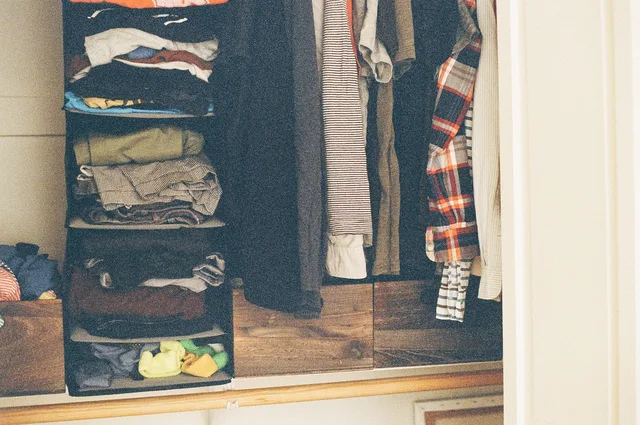
Stacked bins are the cheapest capacity in a small home and the most expensive to use. Reaching the third bin down means moving two, which nobody does twice. Within a month the bottom of the stack is dead storage.
Sterilite clear shoe box bins cost about $1.50 to $2.50 each. Rubbermaid Roughneck totes hold 18 gallons and typically cost $12 to $18.
Shelving that holds each bin separately costs more and is the difference between a system and a pile. ClosetMaid ShelfTrack brackets clip onto a hang track and slide to a new height without tools. The wire version is stocked at Home Depot and Lowe's.
The Container Store's elfa system sits at the other end. A six-foot closet typically runs several hundred dollars before drawers.
Regret four: buying containers before you sort
The most common sequence is bins, then sorting, then discovering the bins are the wrong depth for the shelf and the wrong height for what they hold. Sort, measure, then buy. That order appears in the sixteen approaches for a reason.
IKEA Kallax is where this bites. Its cubbies measure about 13 by 13 inches, so a bin sold as large often does not fit. Inserts that do fit, such as Kuggis, are sold separately at roughly $5 to $15 each.
Regret five: solving one room by exporting to another
Small-home storage projects often end with a cupboard that is beautiful and a hallway that is worse, because the overflow had to go somewhere. If a plan does not say what leaves the house, it is a redistribution plan.
The rented-storage variant is the expensive one. A 5 by 5 foot climate-controlled unit typically runs $50 to $150 a month in most markets, so two years of unopened boxes costs more than the furniture the purge was meant to protect.
The pattern behind all five
Each regret follows the same shape: a decision optimized for capacity rather than for retrieval. The same failure appears in larger projects too, which the wider lessons piece covers in more detail.
Test any idea by asking how many actions it takes to get one item out and put it back. Two is good. Four is where a system starts dying.